Products & Compliance
EcoFlow STREAM kit: setup and registration
EcoFlow’s STREAM kit is sold as something you can install yourself. The plugging in takes a minute; the jobs around it take longer. This is the order to do them in, from the checks before you buy to registering the device afterwards, drawn from EcoFlow’s own guidance and the UK rules.
Written and edited by Christopher Panteli
Christopher is the founder and editor of MyPlugInSolar. He oversees the site’s research standards, data tools and editorial process. He is not an electrician or solar installer, and specialist technical claims are sourced from official documentation or reviewed by appropriately qualified professionals.
Legal to use in Great Britain since 27 August 2026
Before you buy: six checks
- The register entry. Confirm the kit is still listed as Compliant. Is the EcoFlow STREAM kit legal in the UK? gives the references.
- Your consumer unit. Electrical Safety First advises at least a type A bidirectional RCD on the circuit you will use, and an upgrade first if yours is type AC. RCDs, DC leakage and plug-in solar shows how to tell.
- Permission. Tenants and leaseholders need consent before fixing anything. See rented homes and landlord and freeholder permission.
- Planning. In England, a wooden fence, gate, wall, balcony or timber cladding is not permitted development for plug-in solar. See planning permission.
- The spot. A south-facing, unshaded position within 5 m of a socket is the target. What affects output and shading explain why, and the calculator shows what your postcode and direction give.
- Your insurer. Tell them before you install. See home insurance.
This is desk research: EcoFlow UK’s own pages, read on 25 November 2026, and our own reading of the ENA Type Test Register. We have not tested this kit. Links to EcoFlow UK marked “affiliate link” may earn us a commission — see our affiliate disclosure.
What arrives
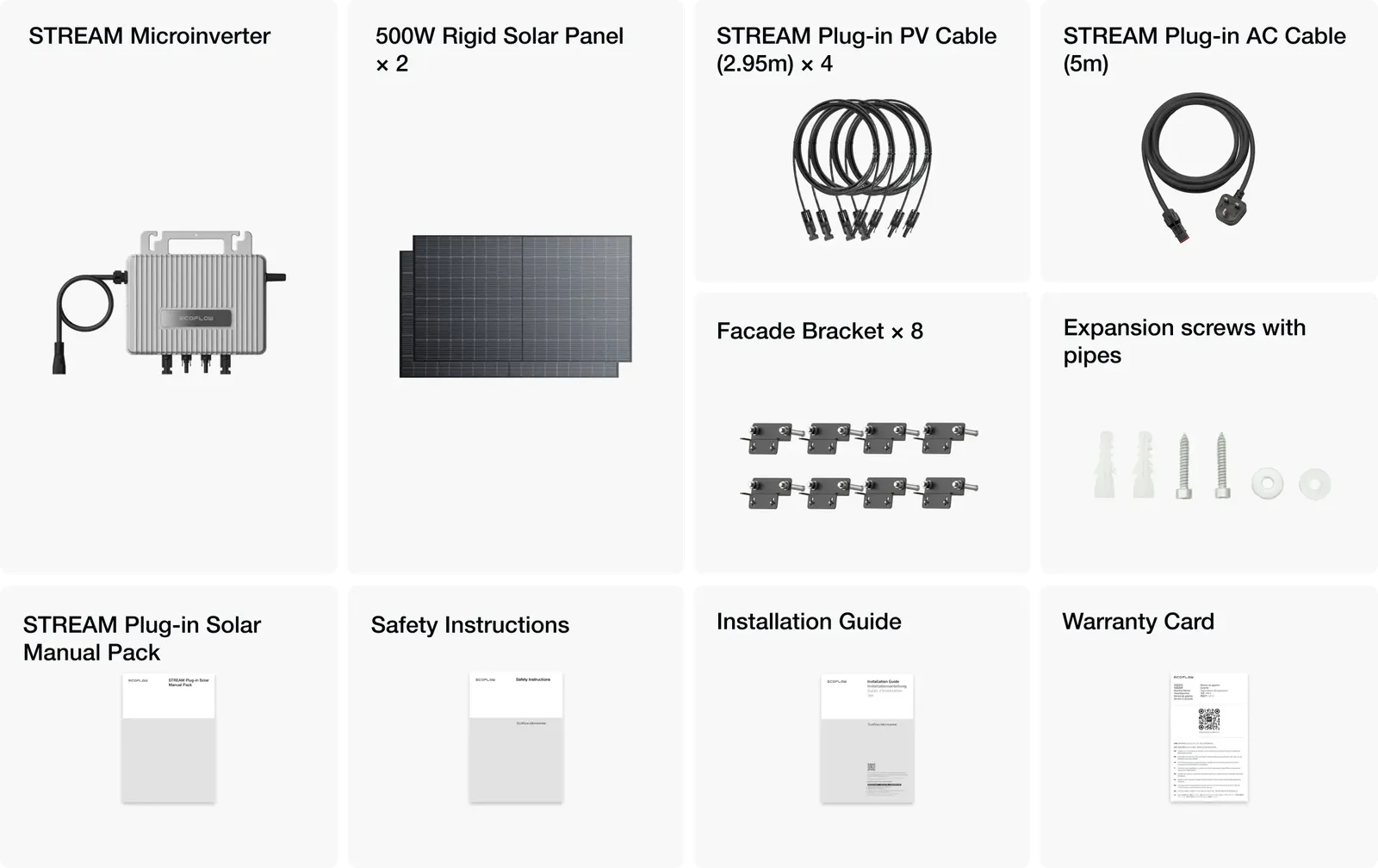
One microinverter, two 500 W panels, a 5 m AC cable with a UK plug, four 2.95 m PV cables, eight façade brackets, screws and the manual pack. Check the box against EcoFlow’s list, and keep the receipt and serial numbers for your insurer and the registration. Our product guide has the full contents table.
Step 1: mount the panels
The brackets in the box are for a façade: the panels sit flat against a wall. Each panel is 1,960 × 1,134 × 30 mm and 26.6 kg, so:
- fix into sound masonry, not render, cladding or a fence panel;
- have a second person for lifting and holding;
- keep the panels clear of shade from gutters, pipes and neighbouring walls;
- if you are not confident drilling and fixing at height, pay someone who is. That does not stop the kit being plug-in.
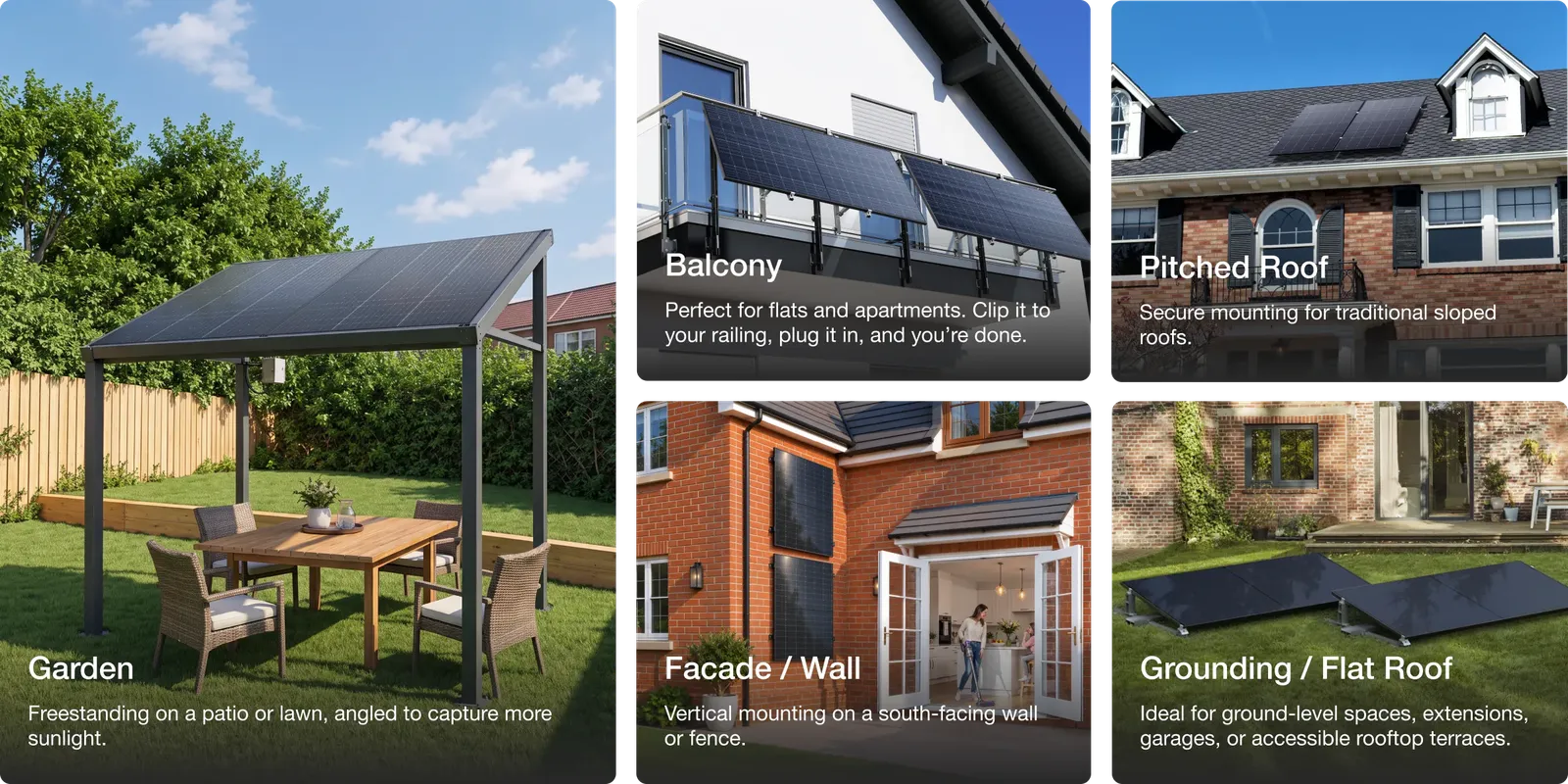
Wall-mounted solar panels covers fixings and what vertical mounting does to output; mounting systems covers the alternatives. EcoFlow shows the panels in other positions too, but only the façade brackets are in the UK box.
Step 2: place the microinverter and connect the panels
EcoFlow’s guidance for the microinverter is to install it “in a well-ventilated, shaded place out of direct sunlight” and “out of reach of children and pets”. It is rated IP67, so it can live outdoors. It runs warm in use; EcoFlow says that is normal and that it has overheat protection.
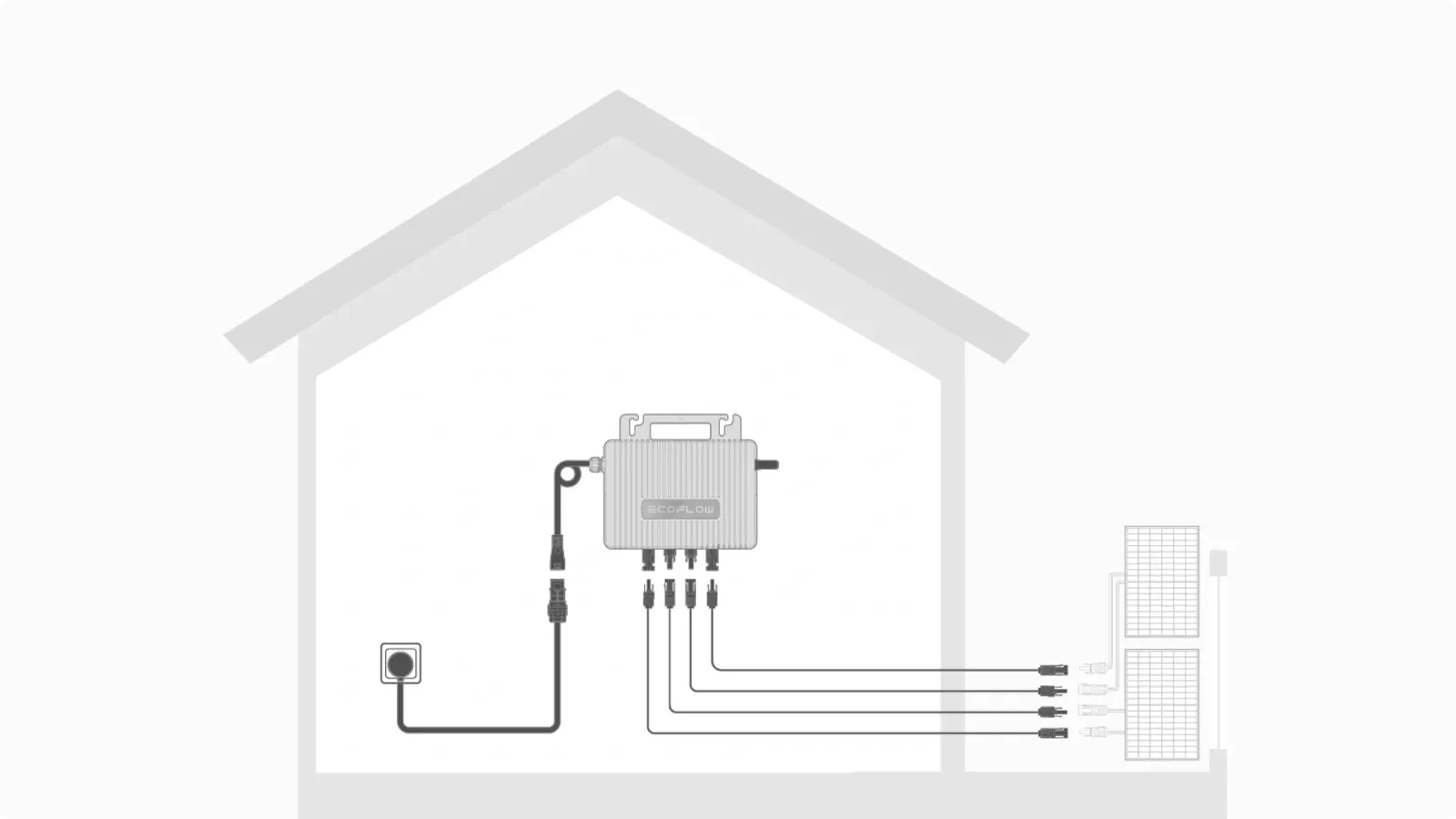
The microinverter has two inputs, one per panel, and the four PV cables connect the panels to it with MC4-type connectors. Push each connector home until it clicks, and never unplug them under load. MC4 connectors explains how they lock and release, and microinverter compatibility why the supplied panels are the ones to use.
Step 3: plug in
Run the 5 m AC cable to a socket and plug it in. EcoFlow is specific about three things:
- Use a fixed wall socket. Asked whether the plug can go into a power strip, EcoFlow answers: “No. Plug it directly into a fixed wall socket”.
- The socket must be properly earthed. EcoFlow says no separate earth is generally needed because the cable has an earthed plug, and recommends you “assess the earthing condition of the wall sockets in your home before installation”. If in doubt, ask an electrician.
- It will not run in a power cut. The system shuts down when the mains fails, by design. See anti-islanding.
With the kit producing, press the test button on your RCD. If it does not trip straight away, switch off and call an electrician.
Step 4: set up the app
The microinverter connects over 2.4 GHz Wi-Fi only, so check you have signal where it is mounted. In the EcoFlow app you can see current power, the day’s generation and the running total, and adjust the output up to the 800 VA maximum. EcoFlow says the unit starts generating once the voltage on a panel input passes 20 V. If you have a smart meter, plug-in solar and smart meters explains what you will and will not see on it.
Step 5: register the device
Registration is a legal requirement, and it is separate from the manufacturer’s register listing. The ENA’s service asks for an email address, your postcode and the device’s make and model; there is no fee. You can only choose a device that is already on its approved list, so confirm the EcoFlow kit appears there. How to register a plug-in solar kit goes through the form, G98 notification explains what it is for, and what is a DNO? explains who receives it.
Do not expect payment for what you export: the Smart Export Guarantee generally asks for an installer’s certificate, which a self-installed kit does not have. The saving comes from using the power yourself — see savings and payback.
Afterwards
- Keep photos of the installation, the receipt and the serial numbers.
- Shift what you can to daylight hours: washing, dishwasher, charging. What an 800 W system can power gives a sense of scale.
- Check the fixings after the first storm and once a year.
- If you move, the kit comes with you; register it again at the new address.
Frequently asked questions
- Can I install the EcoFlow STREAM Plug-in Solar Kit myself?
- Yes, the boxed kit is designed to be plugged into a socket by the owner. Fixing two 26.6 kg panels to a wall is the hard part; pay someone for that if you are not confident, and it remains a plug-in kit. The microinverter sold on its own is different: EcoFlow says it needs an electrician in the UK.
- Can I plug the EcoFlow STREAM kit into an extension lead?
- No. EcoFlow says to plug it directly into a fixed wall socket, not into a power strip.
- Do I need an electrician for the EcoFlow STREAM kit?
- Not to plug in the boxed kit. You may want one to check your RCD type and socket earthing first: Electrical Safety First advises at least a type A bidirectional RCD on the circuit.
- How do I register an EcoFlow STREAM kit?
- Through the ENA’s plug-in solar registration service, with your email address, postcode and the device’s make and model. There is no fee. You can only select a device already on the approved list.
- Does the EcoFlow STREAM kit work on 5 GHz Wi-Fi?
- No. EcoFlow states that only 2.4 GHz Wi-Fi is supported.
Sources
- 1. EcoFlow STREAM Plug-in Solar Kit (UK store, read 25 November 2026) — EcoFlow UK
- 2. ENA Type Test Register (ENA Connect Direct) — “Plug-in Solar” device type, read 25 November 2026 — Energy Networks Association
- 3. Responding to the roll out of plug-in solar panels — Electrical Safety First
- 4. The Town and Country Planning (General Permitted Development) (England) (Amendment) Order 2026 (SI 2026/896) — legislation.gov.uk
- 5. Plug-in solar: regulatory amendment and interim product specification — Department for Energy Security and Net Zero
Estimate your solar potential
See how much electricity a small system could generate at your postcode, and the indicative bill saving.
Related guides
- EcoFlow STREAM plug-in solar kitOur product guide: price, box contents, specifications and register entries.Read more
- Is the EcoFlow STREAM kit legal in the UK?The register entries, the rules that apply to you, and where the kit stops being plug-in.Read more
- EcoFlow STREAM Plug-in Solar Kit: desk reviewWhat the kit does well on paper, where it falls short, and who it suits.Read more
- How to register a plug-in solar kitThe ENA registration service, step by step.Read more
- RCDs, DC leakage and plug-in solarThe consumer-unit check to make before you plug in.Read more
- Wall-mounted solar panelsWhat vertical mounting does to output, and how to fix panels safely.Read more